

As artificial intelligence continues to grow rapidly and reshape the modern world and the global economy, the demand for AI-literate workers is growing exponentially. Recognizing this shift, Sinclair College launched the Sinclair AI Excellence Institute to prepare students for the future workforce.
To discuss the scope, ethics and goals of this endeavor, Luis A. Sanchez Alcazar, Sinclair’s LCS AI Fellow and a faculty member leading the change to integrate these technologies into the curriculum, shared his thoughts.
Related: AI Excellence Institute Announced at Sinclair Press Conference
According to the Pew Research Center, Americans are more concerned about the rate of AI development and the increased daily use of it than they are excited.

Opinions are mixed, with larger shares reporting that such frequent use will decrease a person’s ability to think, while others are more open to using it for assistance for day-to-day tasks.
However, some industries such as welding have benefited not from replacing jobs, but by filling in gaps in the workforce, allowing higher demand to be met. To Alcazar, this is when AI helps companies keep up with demand.
“Companies that work with metal are having a difficult time finding welders to meet demands. So, what ends up happening is AI is now being implemented into these industries to keep up with the demand. It’s not necessarily taking jobs but filling in the gap where we need it,” Alcazar said.
Before the jobs, people will now probably interact with AI at school. Students today are having to learn how to use AI ethically and responsibly in the classroom, rather than simply falling into the temptation of using AI to complete each and every assignment.
“…We rely on AI models to think for us, and that’s problematic, because there needs to be critical thinking occurring before the prompting happens itself.”
LUIS A. SANCHEZ ALCAZAR
Alcazar also believes that AI plays an important role as to how education is traditionally viewed.
“In education, the way we learn has become so traditional, starting with repetition and then moving to application. I don’t care if you memorize or tell me word-for-word what I taught you,” Alcazar said. “I want you to be able to implement this information and use it important fields in your life, and now I think that AI has created an opportunity with an education where we no longer have to focus so heavily on that implementation. It gives us an opportunity to really reassess what it is that we should be assessing students.”
Related: Your Voice: AI in Everyday Life
However, many students have already fallen victim to the temptation of AI. There is research showing reduced cognitive load due to the increasing use of AI. Alcazar believes it is because people don’t know how to use it ethically.
“It’s because we rely on AI models to think for us, and that’s problematic, because there needs to be critical thinking occurring before the prompting happens itself. In other words, ‘garbage in, garbage out,’” he said.
The institute’s immediate challenge is establishing ethical use within the classroom, particularly concerning academic integrity.
As Alcazar emphasized, this means moving beyond simple accusations of cheating toward clear, communicable standards. To guide students and faculty using the CARS (Care, Acknowledge, Review, Support) model.
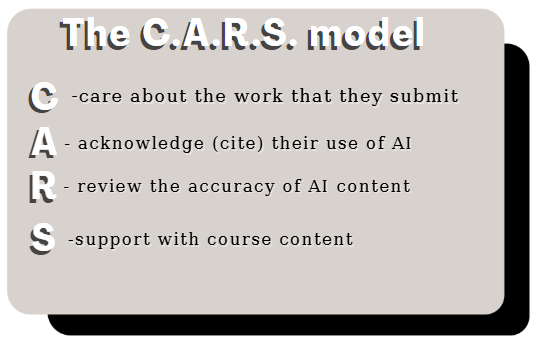
“I have a personal framework called the CARS model. I ask my students that they care about the work that they submit, I ask them to cite their use of AI, I ask them to assess the accuracy of that response from AI, and I ask them to rely on their course content,” Alcazar said.
This framework aligns with the institute’s immediate focus for the academic year: to build confidence and set clear expectations.
By the year’s end, the program aims to strengthen both faculty and student confidence in using AI as an effective learning partner through training, resources and piloting AI-focused assignments.
The ultimate goal is to hold students accountable not for the model’s error, but for their own judgment, transitioning faculty from policing AI use to using it as a “learning checkpoint” to gauge a student’s true understanding.
The long-term vision extends far beyond current academic integrity concerns. The institute’s overarching goal is to embed responsible, ethical and human-centered AI literacy throughout the entire college.
This commitment ensures that regardless of a student’s major, they understand the role AI plays in their field and are prepared for an increasingly AI-driven professional world. Beyond technical expertise, employers are explicitly looking for soft skills—the ability to socialize, engage and work collaboratively.
By embracing the technology, rather than banning it, the college ensures students gain essential social, teamwork and presentation skills to work with AI, amplifying their abilities but not replacing them.
This holistic approach is why students can expect significant changes at Sinclair: A campus culture where AI is not feared, but understood, ethically utilized and leveraged as a powerful tool for intellectual growth.
Danny Bayasgalan, reporter
- A lucky lineup: 5 festive St. Patrick’s Day events in Dayton
- YourVoice: Sinclair students share favorite off campus lunch spots
- Deadlines approach for long-running Paul Laurence Dunbar Poetry and Creative Writing Contests
- Rest and relaxation right here at home – 5 Spring Break destinations in Ohio
- PHOTOS: Sinclair’s Spring Mixer showcases clubs and organizations