

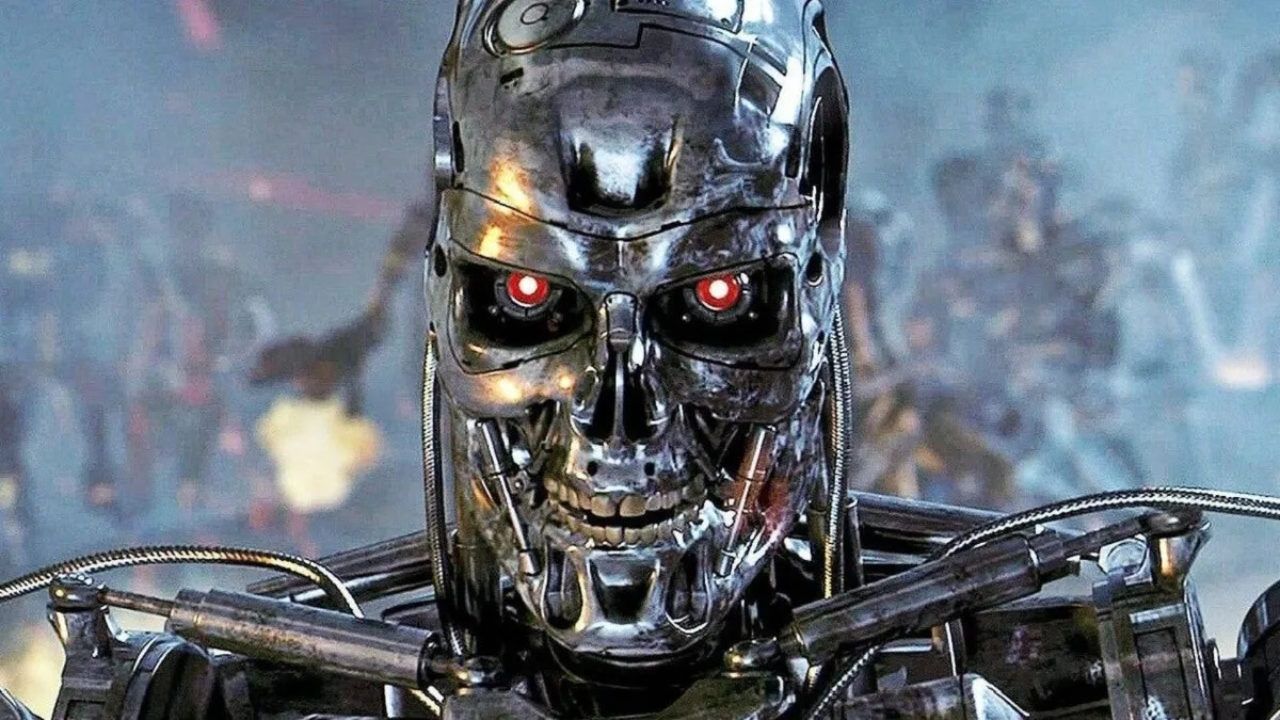
In the past couple of years AI has risen to prominence, and more companies than ever are trying to capitalize on the hype with their own app or website they claim is enhanced by AI. Generative AI has become accessible, and people concerned about AI are more worried about financial insecurity and corporate overreach than they are about a robot apocalypse.

From a modern view the old “Terminator” films, which featured the unseen AI Skynet as the main antagonistic force, can seem rather quaint. Nowadays a malevolent AI bringing about the world-ending “Judgement Day” feels overblown compared to the more mundane threats AI is posing in the real world.
But while the fears about nuclear war and robot uprisings seem dated, the “Terminator” films ended up providing a highly relevant cautionary tale about AI, just not in the way most people would expect.
To date there have been six “Terminator” films. The first two were original, creative passion projects with a clever concept that was executed incredibly well, with the hard work of countless talented people coming together to bring the world two all-time classics.
The premise of two individuals arriving from the future, one being a Terminator on a mission to terminate a person in the past to alter the future and the other being a protector trying to stop the Terminator, was intriguing in the original film and successfully captivated audiences. In many ways, “Terminator 2” played out very similarly to the first, yet it still felt fresh because the twists on the formula were game changing rather than superficial.

It upped the ante with bigger set pieces, better special effects, and more fleshed out characters. On top of that the callbacks to the original film felt organic and earned rather than like heavy-handed fan service, and many of the roles were reversed in new and exciting ways, offering an unforgettable experience that was even better than the first film.
Yet despite the latter four films also having incredibly talented people working on them, none of them are regarded as highly as the first two, being seen as mediocre at best and garbage at worst. This is because while the films did have good creative ideas, they also didn’t have enough faith in these ideas. They weren’t willing to take actual risks, and instead chose to recycle the same narrative threads and concepts of the original two films.
The problem is that doing the same thing again, even if it’s good, is always going to feel underwhelming because people have already seen it, and it’s not exciting or interesting anymore. While “Terminator 2” elevated the formula and earned its callbacks, the sequels ended up simply repeating the formula and fell right into the pitfalls that make a continuation of a beloved story feel embarrassing rather than endearing.
The tragedy is that all four of the later Terminator films did have fresh new ideas which could have offered something truly unique that the first two didn’t. In particular the fifth and sixth films really tried to have novel premises that shook things up. But they couldn’t follow through, and instead of fleshing out their new ideas they fell back on the same tropes as always.

Despite their best efforts to take the series in a new direction, they still somehow ended up telling the same story yet again, except executed far worse. The result is sparks of originality drowned out by how overwhelmingly derivative the movies ended up being.
Which brings us back to the real problem with AI.
Generative AI remains controversial because while it does have some practical applications, it can’t actually generate anything truly new, it can only rearrange preexisting ideas. Consequently the AI still needs the creative input and feedback of a human guiding it to produce something that’s actually good and original. Without that, it just produces derivative slop.
But as the lackluster quality of the later Terminator films demonstrates, derivative slop is not a new problem, it’s one that’s been with us for a very long time. AI makes slop more visible and easier to churn out, but risk-averse, creatively empty entities have been producing slop for as long as any of us have been alive.

True creativity and quality requires the talent and passion to make something truly unique, and this can’t be achieved by just trying to cynically recreate the success of the old. Yet many profit-focused entities keep trying to reduce art down to a formula that can be exploited, and being surprised every time this approach fails.
Rather than being a recent issue, AI slop is merely a new variation of a familiar human vice, and the human vice is the real source of the problem.
The primary lesson we get from the “Terminator” films is that technology is completely amoral. It can be used for good or evil, and assuming that technology will be our savior or our destroyer is simplistic, even wishful, thinking.
If technology saves us it will be because humans applied and directed it correctly, and if technology destroys us it will be because it was doing what humanity programmed it to do. It’s easy to scapegoat controversial technology, it’s not so easy to focus on the humans behind the technology, whose use is the root of the issue. But ignoring the human element only hinders our ability to understand the problem and find potential solutions–both when it comes to AI and our future.
Erik Larson, reporter